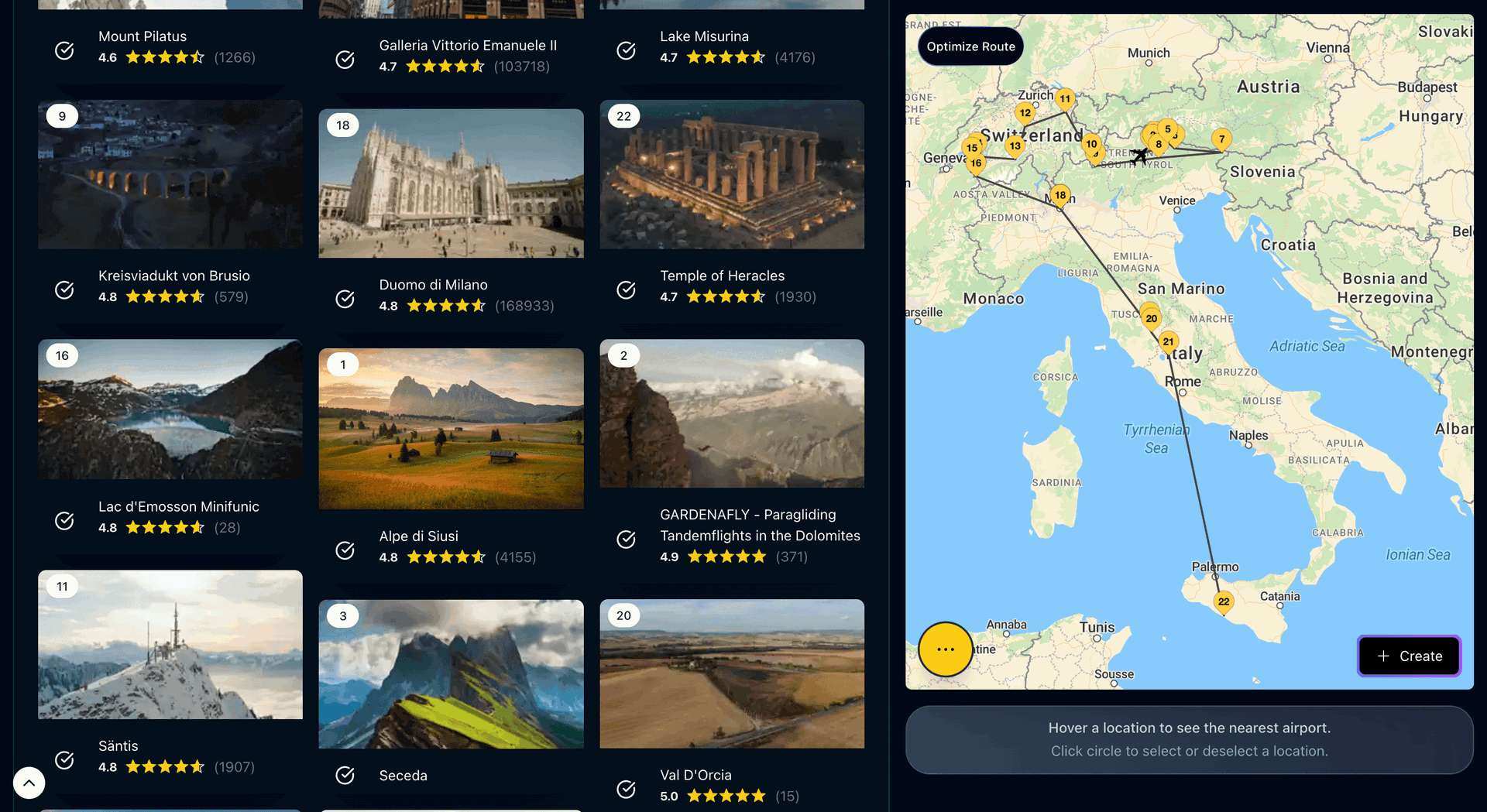
The short answer: pick neighboring countries in one region, give each country at least 4–5 full days, collect the specific places you want to see country by country, put everything on one map and order the countries so the route never backtracks, check visas and intercity transport, then convert the shortlist into a day-by-day itinerary and book flights first. The collecting, mapping and day-planning — the part that usually eats your evenings — is exactly what the free Map Your Voyage planner automates: you shortlist places from curated travel reels for as many countries as you want, they collect on a single interactive map, and one click builds a day-by-day, hour-by-hour itinerary across every country.
Multi-country trips fail in the planning, not the traveling: six browser tabs, a spreadsheet, a Google Maps list per country, and no single view of how it all connects. This guide walks through the seven steps that prevent that — the honest math on how many countries fit your days, how to shape a route that never doubles back, the visa rules that actually matter, and how to end up with one itinerary instead of three half-plans. Every step works with any tools; we'll also show where Map Your Voyage collapses an evening of work into minutes.
Want to skip ahead? Open the planner, pick your first country, shortlist places from curated travel reels, switch countries and keep going — then click Create for a day-by-day itinerary across all of them. Free, unlimited itineraries.
Start my multi-country plan →Step 1: Pick One Region, Not a Wishlist
The single biggest decision is made before any booking: choose countries that share borders or short, cheap connections, all within one region. Japan, Greece and Peru are each wonderful — together they are three separate trips wearing one trench coat. Every long-haul hop between regions costs you a full day, a chunk of budget and a jet-lag reset.
Regions that work beautifully for a first multi-country trip:
- Western Europe — France, Switzerland and Italy connect by scenic trains measured in hours, not days.
- Central Europe — Germany, Czech Republic, Austria and Hungary line up four capitals along one train line.
- Southeast Asia — Thailand, Vietnam and Cambodia are stitched together by one-hour budget flights and overnight buses.
- Iberia — Spain and Portugal make a natural two-country pair, as do Japan and South Korea in East Asia.
Not sure which region is calling you? Browse the destinations grid — hovering a country highlights it on the world map, which makes neighboring clusters obvious — or scroll the travel inspiration feed and notice which region keeps stopping your thumb.
Step 2: Match the Number of Countries to Your Days
This is where most multi-country plans quietly die. The math is unforgiving: every country change costs half a day to a full day — checkout, transit, border or airport time, check-in, re-orientation. Add too many countries and your “trip across Europe” becomes a tour of train stations.
The rule of thumb that holds up: at least 4–5 full days per country, and be honest about travel days — they are not sightseeing days.
| Trip length | Countries that fit well | Feels like |
|---|---|---|
| 7 days | 1 (2 only if very close) | One country done properly beats two done breathlessly |
| 10 days | 2 | A natural pair — Spain + Portugal, Thailand + Cambodia |
| 14 days | 2–3 | The sweet spot for a classic three-country route |
| 21 days | 3–4 | Room for smaller towns, not just capitals |
| 30+ days | 4–6 | A proper regional loop at a humane pace |
If your list of countries exceeds the table, you don't need a faster pace — you need a second trip. The places you cut aren't lost, either: keep them saved in a country-specific bucket list (more on that in Step 3) and they become the seed of the next itinerary.
Step 3: Collect Places Country by Country
“Italy” is not a plan. An itinerary is built from specific places — the viewpoint, the old town, the beach, the food street — and the fastest way to find the ones that genuinely excite you is to watch them, not read about them.
The traditional approach is hours of blog posts and a growing folder of Instagram saves and screenshots that never make it anywhere useful. The structured approach, in the Map Your Voyage planner, takes minutes per country:
- Pick your first country from the dropdown (every one of 250+ countries is there) and scroll its curated Instagram travel reels, videos and photos — hand-picked footage of that country's top spots, each with a human-verified geolocation.
- Tap the circle under anything you love. The place instantly drops onto the interactive map beside the feed — no typing, no copy-pasting names into a spreadsheet.
- Switch to your next country from the same dropdown and keep selecting. Your shortlist keeps growing on the same map, country after country.
Already have research of your own? Paste links to Instagram reels and posts, YouTube videos or travel blog posts into the planner's search bar, and the locations are detected automatically from the actual footage, the caption and any text in the footage — pasting is unlimited and free. You can even DM reels to Map Your Voyage on Instagram as you scroll, and everything files itself into country-specific bucket lists. The full workflows are in our guides to planning trips from Instagram and finding where a reel was filmed.
Aim for 5–10 places per country — enough to shape real days, few enough to leave room for wandering.
Step 4: Shape the Route on One Map
Now the payoff for collecting everything in one place: look at the map, and let geography pick your route. The right order of countries is usually obvious the moment you see every pin together — and invisible when your research lives in separate lists, tabs and screenshots.
- Travel in one direction. West to east, north to south — any direction works as long as the line never doubles back. Backtracking is how trips lose entire days.
- Fly open-jaw. Fly into the first city of the route and home from the last (booked as a “multi-city” ticket). It usually costs about the same as a round trip and saves the dead leg back to your arrival airport.
- Let clusters promote and demote places. Three pins within an hour of each other justify an extra day in that area; a lone pin six hours off the line has to be truly special to survive the cut.
In Map Your Voyage, this step is simply looking at the map you already built — every shortlisted place from every country is plotted together, so clusters, gaps and the natural line through them are visible at a glance. If you enjoy comparing tools for this job, we've reviewed the best apps to plot locations on a map and optimize routes.
Step 5: Sort Visas, Borders and Transport
The unglamorous step that saves trips. Three things to check before anything is booked:
Visas and entry rules
Rules depend on your passport, not just the destination. The good news for Europe: one Schengen short-stay visa covers 29 countries — including France, Switzerland, Italy, Germany, Austria, Czech Republic and Hungary — with a shared limit of 90 days in any 180-day window that counts across the whole area, not per country. (Europe's border systems are also being modernized — the EU's new EES is rolling out and ETIAS is expected to follow — so check requirements close to departure.) In Southeast Asia, each country sets its own rules, and many offer quick e-visas or visa-free entry depending on your passport. Always confirm with each country's official government source — rules change.
The legs between countries
Decide how you'll cover each border: train (city center to city center, no baggage fees — the default in Europe), budget flight (the default for longer hops and most of Southeast Asia), or bus/ferry (cheapest, slowest). Book trains with the national rail operators and flights with the airlines or a comparison engine; our roundup of the best travel apps covers the booking toolkit in detail.
The small stuff
Multiple countries can mean multiple currencies (Switzerland and Czech Republic don't use the euro; every Southeast Asian country has its own), so favor a low-fee card. A regional eSIM keeps data working across borders, and travel insurance should cover every country on the route.
Step 6: Turn the Shortlist into a Day-by-Day Itinerary
This is the step where spreadsheets go to die: distributing thirty places across twelve days, in a sensible order, with realistic travel time between them — across three countries. Done by hand it's an evening of Google Maps tab-juggling per city.
In Map Your Voyage it is one click: Create. Your entire shortlist — every country — becomes a day-by-day, hour-by-hour itinerary, sequenced so nearby places share a day and each day flows efficiently instead of zig-zagging across town. Want the Eiffel Tower at sunset instead of 9 a.m.? Drag and drop to fine-tune. Building itineraries is free and unlimited, so you can generate one per route variation you're debating and compare.
However you build it, sanity-check the result against two rules: no more than 2–3 anchor places per day, and country-change days carry at most one light activity. An itinerary you finish at 70% energy beats one you abandon by day four.
Shortlist places from two or three countries, click Create, and watch them become one day-by-day, hour-by-hour itinerary — free, as many times as you like.
Build my itinerary →Step 7: Book It — Yourself, or Hands-Off
With the itinerary locked, book in this order so each layer can flex around the previous one:
- International flights — the open-jaw pair into your first city and out of your last.
- Intercity legs — cross-border trains and budget flights, where prices climb steeply close to the date.
- Stays — now that arrival and departure times per city are known, book accommodation near each city's cluster of pins.
- Activities and time-slot attractions — the handful that genuinely sell out; leave the rest spontaneous.
Prefer to skip the booking marathon entirely? Map Your Voyage also offers a human concierge: submit your trip requirements — or attach the itinerary you just built — and a fully customized multi-country trip comes back with hotels, flights and activities booked for you, backed by a price-match guarantee. The quote is free and arrives within 24 hours, with no account required.
Three Proven Multi-Country Routes
Three classics that follow every rule above — one direction, short hops, realistic pacing. Use them as-is or as skeletons for your own variation.
The Western Europe classic: France → Switzerland → Italy (12–16 days)
Paris (4 days) → train to the Swiss Alps — Interlaken or Lucerne (3 days) → train south to Venice (2 days) → Florence (2 days) → Rome (3 days), flying home from Rome. One Schengen visa covers all three countries, and every leg is a daytime train with scenery doing the in-flight entertainment. Start collecting places for France, Switzerland and Italy.
Central Europe by train: Germany → Czech Republic → Austria → Hungary (10–14 days)
Berlin or Munich (3 days) → Prague (3 days) → Vienna (3 days) → Budapest (3 days), flying home from Budapest. Four capitals on one line, each train hop around four hours or less, and all four countries inside Schengen — though three different currencies (euro, koruna, forint), which is exactly the kind of detail Step 5 exists for. Browse Germany, Czech Republic, Austria and Hungary.
The Southeast Asia loop: Thailand → Vietnam → Cambodia (2–3 weeks)
Bangkok (3–4 days) → fly to Hanoi and work south through Vietnam — Ha Long Bay, Hoi An, Ho Chi Minh City (7–9 days) → Siem Reap for Angkor Wat (3 days) → short flight back to Bangkok for the trip home. Budget airlines make every hop about an hour; visas are per-country (e-visas for most passports), so this route is the textbook case for checking entry rules early. Start with Thailand, Vietnam and Cambodia.
Common Multi-Country Planning Mistakes
- Country-counting. Six countries in ten days is a transit itinerary with sightseeing sprinkled in. Cut until every country gets its 4–5 days.
- Booking a round trip before shaping the route. Flying in and out of the same city forces a backtrack. Route first on the map, then book open-jaw.
- Counting travel days as sightseeing days. A border-hop day delivers one light activity at best. Twelve days with three country changes is really ten.
- Leaving research in saved folders and screenshots. Places that never reach a map can't shape a route — that gap is exactly why flat saved lists fall short for trip planning.
- Ignoring the visa clock. Schengen's 90-in-180 limit counts the whole area as one. Long European trips need that math done before booking, not at the border.
- Routing by wishlist order instead of geography. The order you thought of the countries in is not a route. The map decides — let it.
Frequently Asked Questions
How do you plan a multi-country trip?
Pick neighboring countries in one region, give each country at least 4–5 full days, collect the specific places you want to see in each country, put everything on one map and order the countries so the route never backtracks, check visas and intercity transport, then turn the shortlist into a day-by-day itinerary. Map Your Voyage handles the hardest parts for free: shortlist places from curated travel reels country by country, watch them collect on one interactive map, and click Create for a day-by-day, hour-by-hour itinerary covering every country.
How many countries should I visit in one trip?
Plan a minimum of 4–5 full days per country, plus half a day to a full day lost to every country change. One week suits a single country (two at most if they're very close), two weeks comfortably covers 2–3 countries, three weeks covers 3–4, and only month-long trips justify five or more. Fewer countries almost always means a better trip.
Is there a free app to plan a trip across multiple countries?
Yes. Map Your Voyage is free for discovering places, building country-specific bucket lists and generating unlimited day-by-day, hour-by-hour itineraries — including itineraries spanning several countries on one map. You only pay if you choose the optional concierge service to book the trip for you. General tools like Google Maps lists or spreadsheets work too, but they leave the routing and day-planning to you — we compare the options in best apps to build customized travel itineraries.
Can I plan a multi-country trip from Instagram reels?
Yes. In the planner you watch curated Instagram travel reels for one country, tap the circle under the ones you like, switch to the next country from the dropdown and keep going — every selected place collects on a single map with human-verified geolocations. You can also paste links to reels, posts, YouTube videos or blog posts you found yourself, and the locations are detected automatically from the footage and caption. See the full flow in watch Instagram reels and plan a trip.
Do I need a separate visa for every country I visit?
It depends on the region and your passport. In Europe, one Schengen short-stay visa covers 29 countries with a shared 90-days-in-any-180 limit that counts across the whole area. In Southeast Asia and most other regions, each country has its own rules — often quick e-visas or visa-free entry, depending on your passport. Always verify with each country's official government source before booking.
Should I book flights before or after planning the route?
Route first, then book. Once your places are on one map, the natural order of countries — and therefore your entry and exit cities — becomes obvious. Then book an open-jaw (multi-city) ticket into the first city and home from the last, so you never pay time and money to loop back to your arrival airport.
Can Map Your Voyage build one itinerary across several countries?
Yes — that's its core flow. Shortlist places from as many countries as you want, and clicking Create builds a single day-by-day, hour-by-hour itinerary covering all of them, sequenced so each day flows efficiently. Fine-tune with drag and drop; building itineraries is free and unlimited.
Can someone book my whole multi-country trip for me?
Yes. Submit your trip requirements — or attach the itinerary you built — and Map Your Voyage's concierge prepares a fully customized multi-country trip with hotels, flights and activities booked for you, backed by a price-match guarantee. The quote is free and arrives within 24 hours, and no account is required.
Plan all of it on one map — then let one click build the itinerary
Shortlist places from curated travel reels country by country, watch every selection land on a single interactive map, and turn the whole thing into a day-by-day, hour-by-hour itinerary — free, unlimited. And if you'd rather have humans book the hotels, flights and activities, the concierge quote is free and arrives within 24 hours.