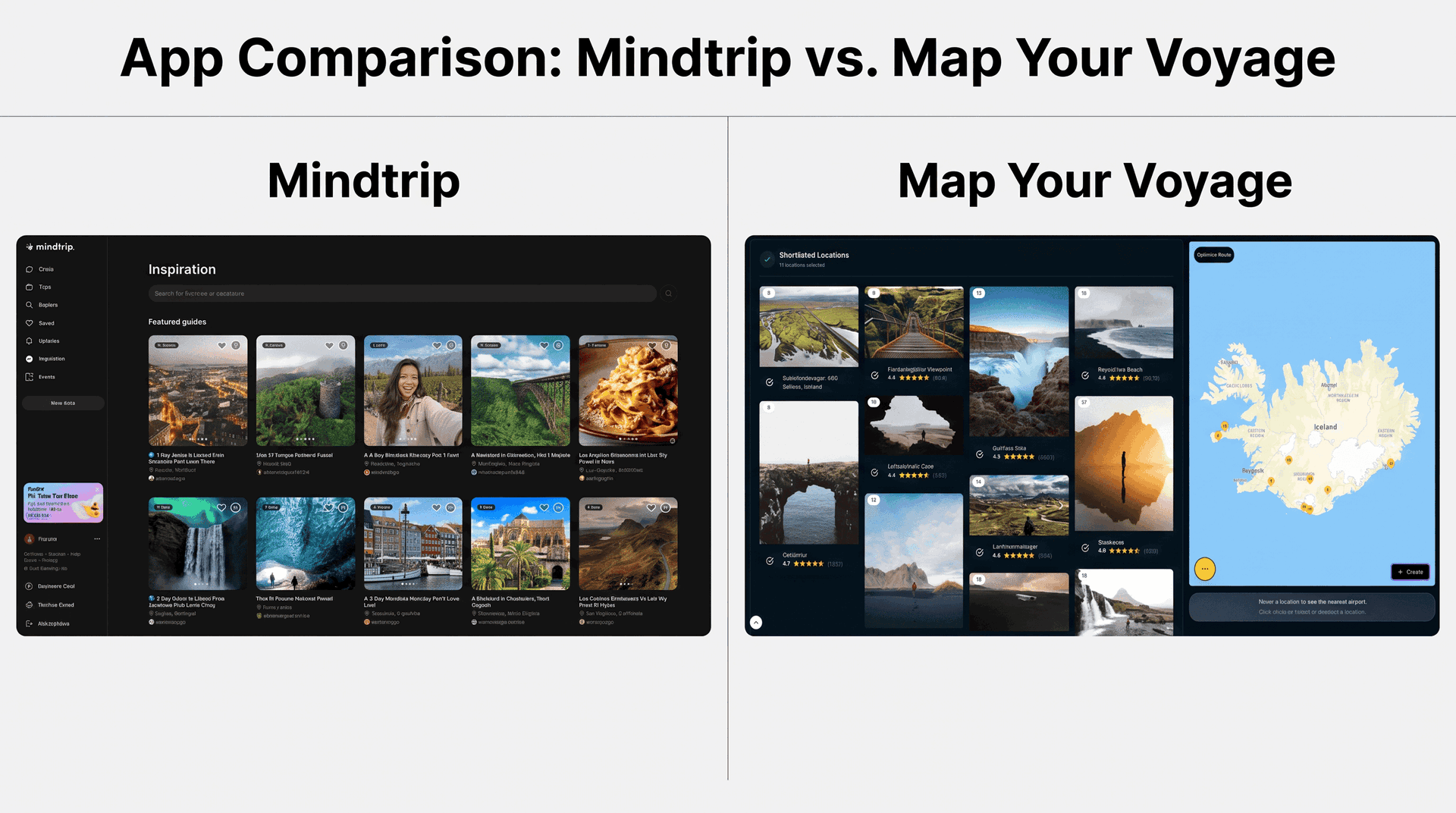
Choosing a travel planner in 2026 isn't really about spreadsheets versus guidebooks anymore. The real choice is between AI assistants that generate suggestions from across the web and tools that build your trip from real, visual, human-verified content. Two names that come up a lot in that conversation are Mindtrip and Map Your Voyage.
On the surface they sound similar — both help you discover places, build an itinerary, and see everything on a map. But under the hood they answer one crucial question very differently: where do the recommendations actually come from, and can you trust them? This guide compares both honestly so you can pick the one that fits how you like to plan.
Already know where you want to go? Skip the reading and start building an itinerary from real travel content in minutes.
Try the travel itinerary planner →The Short Version
| Mindtrip | Map Your Voyage | |
|---|---|---|
| Core idea | Conversational AI that generates trip suggestions | Plan from real Instagram travel content with verified locations |
| How you discover | Chat prompts and AI text answers | Watch real reels, videos and photos, then shortlist |
| Source of truth | OpenAI + an 11M+ point-of-interest database (photos, reviews, maps) | Curated creator content + human-verified geolocations |
| Accuracy | Grounded in real POI data, but AI can still get details wrong | You watch the place on video first; pins are human-checked |
| Itinerary | AI day-by-day plan you refine in chat | Day-by-day and hour-by-hour from your shortlisted spots |
| Booking | In-app booking via partners (Sabre flights, Priceline, Viator) | Optional human concierge with a price-match guarantee |
| Pricing | Free; no meaningful paywall on core features | Free to plan; pay only if you book a custom trip |
| Best for | People who like brainstorming a trip with an AI | People inspired by Instagram who want to actually go there |
What Is Mindtrip?
Mindtrip is an AI-powered travel planning platform built around a conversational assistant. You describe the trip you want in plain language — something like “five relaxed days in Lisbon with great food and one day trip” — and the AI responds with destination ideas, hotels, restaurants, and activities, organizing them into an itinerary you can refine through follow-up questions. It's built in partnership with OpenAI on top of a proprietary database of more than 11 million points of interest (with photos, reviews, and maps), and it won a Fast Company “Most Innovative” award in 2025.
Its standout features include:
- Chat-first planning. Almost everything starts with a prompt. You ask, adjust, and re-ask until the plan feels right, with the itinerary updating in real time.
- Interactive map. Suggested places appear on a live map so you can see how a trip clusters geographically.
- “Start Anywhere.” Kick off a plan from a photo, screenshot, PDF, or a pasted blog or video link — not just a typed prompt.
- Collections & imports. Save places into themed collections and import saved locations from Google Maps.
- Collaboration. Plan with friends in real time through shared trips and group chat.
- In-app booking. Mindtrip integrates booking for flights, hotels, and activities through partners (a Sabre- and PayPal-powered agentic flight tool, plus Priceline and Viator), so you can go from plan to reservation without leaving the app.
- Mobile and sharing. A well-rated iOS app and full functionality on mobile web.
Mindtrip is genuinely good at what it does. If you enjoy brainstorming with an assistant and want a fast, data-rich first draft of a trip from a blank page, it removes a lot of friction. It also offers tools for travel advisors and businesses, which signals a serious product.
The trade-off: it's still an AI assistant. Being grounded in a real POI database helps a lot, but as with any AI planner you're trusting a model to interpret your taste, and reviewers note rough edges — for example, hotel filters that sometimes return options outside the budget you set. The plan looks confident and complete even when a detail is off, so it's worth a quick fact-check on the stops that matter most.
What Is Map Your Voyage?
Map Your Voyage takes the opposite starting point. Instead of asking an AI to describe places, it lets you see them first — through curated Instagram travel reels, videos, and photos from real creators — and then plan from the spots you actually liked.
Here's how a typical session works:
- Open a country page under Destinations or jump straight into the Travel Itinerary Planner and watch curated reels of that destination's top spots.
- When a reel makes you think “I want to go there,” tap the circle icon below it to shortlist that location.
- Every shortlisted place drops onto an interactive map with a human-verified geolocation, so you know exactly where it is — not an AI's best guess.
- Hop between countries in one session, building a list across multiple destinations.
- Hit create, and Map Your Voyage generates a day-by-day and hour-by-hour itinerary that routes you efficiently through everything you picked.
There's also a Travel Inspiration feed for endless scrolling and bucket-list building, and you can even DM Instagram links to save reels into country-specific bucket lists automatically (more on that in our guide to planning trips from Instagram). When you want someone else to handle the logistics, the Book a Custom Trip service has a human team arrange hotels, flights, and activities for you.
Where the Recommendations Come From
This is the single biggest difference, so it deserves its own section.
Mindtrip generates recommendations by combining a large language model with its 11M+ point-of-interest database and reviews. The benefit is breadth and speed — it can answer almost anything instantly and back it with photos, hours, and ratings. The catch is that you're still reading the model's synthesis of a place rather than seeing it, and AI can be confidently off about specifics.
Map Your Voyage shows you a real video of the place before it ever lands in your plan. You're not reading a paragraph that claims a viewpoint is stunning — you're watching footage of it. And because each location's pin is human-verified rather than auto-extracted, the spot on the map is the spot in the reel. For travelers who have been burned by “the app sent me to the wrong place” stories, that verification is the whole point.
Building the Itinerary
Both tools produce a structured, day-by-day itinerary, and both let you adjust it.
With Mindtrip you shape the plan conversationally — “make day two more relaxed,” “add a beach afternoon” — and the AI rewrites it. It's flexible and fast, ideal if you like iterating in chat.
With Map Your Voyage the itinerary is assembled from places you already chose because you saw and liked them. The output goes deeper than most planners, breaking the trip down hour-by-hour and ordering stops to minimize backtracking — and you can still drag activities between days or add new locations afterward. Because every stop started as something you watched, the finished plan feels less like a generated draft and more like a trip you curated yourself.
Maps & Visualization
Both put your trip on an interactive map, and this is genuinely useful in both products for spotting when a plan zigzags across a city. The difference is what sits behind each pin: in Mindtrip a pin is an AI-suggested place; in Map Your Voyage a pin is a place you watched in a reel, with a location a human confirmed. Same map, very different confidence level.
From Plan to Actually Booking
A plan is only useful if you can act on it.
Mindtrip is strong here: it integrates booking directly, with an agentic flight tool powered by Sabre and PayPal plus hotel and activity booking through partners like Priceline and Viator. You can move from itinerary to reservation without leaving the app, and you stay in control of each piece.
Map Your Voyage offers a different model. You can plan everything free and book on your own — or hand the finished itinerary to its custom trip service, where a human team assembles the entire trip: hotels, flights, and activities. It comes with a price-match guarantee (the promise that prices will be lower than booking online yourself), a free quote delivered within 24 hours, and no account required to request one. If you'd rather not stitch together ten tabs of booking sites, that concierge layer is something a pure AI chat tool doesn't offer.
Pricing
Mindtrip is currently free to use, with no meaningful paywall on its core itinerary features — it earns primarily through its booking partners. That makes it very easy to try, though it's reasonable to expect optional paid tiers may appear as the product matures.
Map Your Voyage is free to use for discovery and itinerary building — browsing reels, shortlisting locations, and generating your day-by-day plan cost nothing. You only pay when you choose to book a custom trip, and that price comes with the price-match guarantee. There's no subscription required just to plan.
Pricing and plan limits change over time, so always check each provider's current pricing page before deciding.
Who Should Use Which?
Choose Mindtrip if…
- You love a chat-first, ask-anything experience and want a trip draft from a blank page in seconds.
- You're planning somewhere niche and want an AI to brainstorm broadly before you narrow down.
- You want deep booking baked in — flights, hotels, and activities in one place, backed by a large POI database.
- You're a travel advisor looking for AI tooling to speed up client planning.
Choose Map Your Voyage if…
- Your wanderlust comes from Instagram, and you want to plan from the exact reels that inspired you.
- You want to see a place on video before trusting it — not read an AI's description.
- Accuracy matters: human-verified geolocations mean the pin is the place.
- You want a detailed hour-by-hour itinerary, not just a loose day plan.
- You'd like the option of a human concierge to book the whole trip with a price-match guarantee.
- You want to plan for free without a subscription.
Ready to turn the reels you already love into a real, mapped, hour-by-hour trip?
Build my itinerary →The Verdict
If your ideal planning session is a back-and-forth chat with a clever assistant and you don't mind double-checking the details, Mindtrip is a strong, modern AI travel planner worth trying.
If you're the kind of traveler who saves reels of turquoise coves and hidden alley cafés and thinks “I want to go there,” Map Your Voyage is built for exactly that instinct. It turns the content that inspired you into a verified, mapped, hour-by-hour trip — and optionally books it for you. There's no risk of being sent to a place that doesn't look like its description, because you watched it first.
Plenty of travelers will use both: brainstorm broadly with an AI assistant, then validate and finalize with real, human-verified content. But if you have to pick the tool that takes you from inspiration to a trip you can actually trust, that's where Map Your Voyage shines.
Frequently Asked Questions
What is the difference between Mindtrip and Map Your Voyage?
Mindtrip is a conversational AI travel planner — built with OpenAI on a database of 11M+ points of interest — where you chat to generate itineraries and can book flights, hotels and activities in-app. Map Your Voyage lets you plan from real Instagram travel reels and posts with human-verified geolocations, so you watch a place on video before adding it to your map and itinerary.
Is Map Your Voyage a good Mindtrip alternative?
Yes — especially if your travel inspiration comes from Instagram and accuracy matters to you. Instead of trusting an AI's text description, Map Your Voyage builds your day-by-day and hour-by-hour itinerary from spots you watched in real reels, each with a human-verified location, and offers an optional human concierge to book the whole trip.
Does Mindtrip or Map Your Voyage cost money?
Mindtrip is currently free to use, with no meaningful paywall on its core itinerary features (it earns through booking partners and may add paid tiers later). Map Your Voyage is also free for discovering places and building itineraries; you only pay if you choose to book a fully customized trip, which comes with a price-match guarantee.
Is Mindtrip free?
Yes. As of 2026 Mindtrip is free to use with no meaningful paywall on its core itinerary features; it monetizes through booking partners such as Sabre, Priceline and Viator. It may introduce optional paid tiers in the future.
What is the best Mindtrip alternative for planning from Instagram?
Map Your Voyage is the closest alternative for travelers inspired by Instagram. Instead of generating suggestions with AI, it lets you shortlist places from curated, human-verified Instagram reels and turns them into a day-by-day, hour-by-hour itinerary on an interactive map, with an optional human concierge to book the trip.
Can AI travel planners give wrong recommendations?
Yes. AI planners generate answers from training data and the web, so they can recommend places that have closed, misjudge distances or opening hours, or suggest generic tourist traps. Planning from real, human-verified content reduces that risk because you see the actual place before committing to it.
Sources & further reading
- Mindtrip official website — product features and overview.
- Mindtrip's agentic flight booking launch (PR Newswire) — Sabre and PayPal booking partnership.
- Mindtrip on the App Store — mobile app and ratings.
- Best AI apps to build customized travel itineraries — our wider roundup of AI trip planners.
Product details reflect publicly available information at the time of writing (May 2026) and may change.